What Is a Marketing Funnel? A Plain-English Guide for Small Business Owners
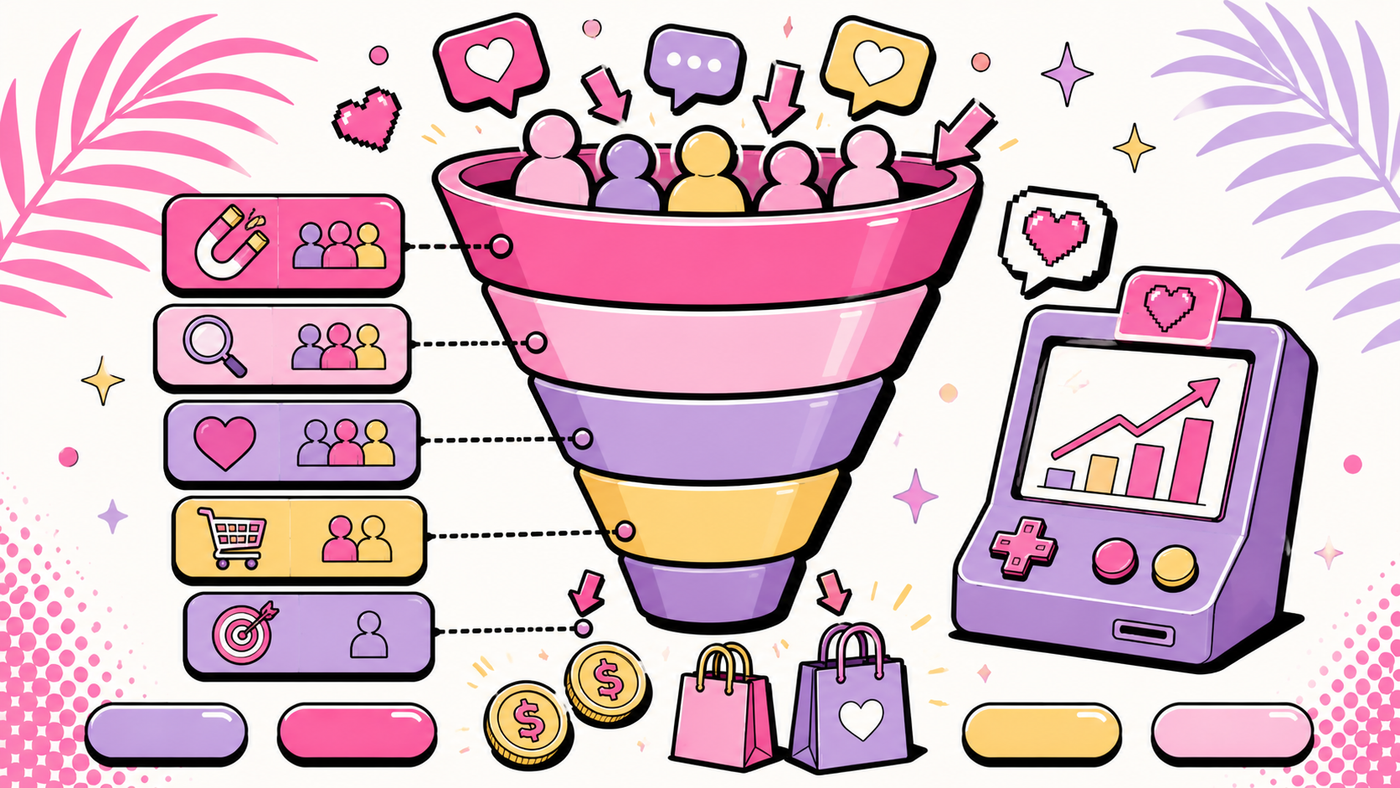
"Marketing funnel" is one of those phrases that gets thrown around in meetings until it stops meaning anything. Someone says it, everyone nods, and nobody actually asks what happens between "saw your Instagram post" and "handed over their credit card." That gap is the whole game. 💖
Here's the plain-English version: a funnel is every step a person goes through on the way to becoming your customer, and every step after that where you either keep them or lose them. It's called a funnel because you start with a lot of people at the top (everyone who could theoretically buy from you) and end with a smaller group at the bottom (people who actually do). Most of that drop-off is normal. Some of it is you leaving money on the table because nobody mapped the middle bit.
First, what most small businesses get wrong
- Treating "get more traffic" as the whole strategy — more people arriving at a funnel with holes in it just means more people falling through the holes, faster.
- Having no middle stage at all — a website and a "Contact Us" button is not a funnel, it's a hope. There's nothing for someone who isn't ready to buy today.
- Assuming the funnel ends at the sale — the businesses that grow fastest treat the first purchase as the start of the relationship, not the finish line.
- Copying someone else's funnel — a real estate agent and a physio don't sell the same way, on the same timeline, to the same level of trust. The stages are the same shape; what fills them isn't.
The four stages, in plain English
Every funnel is a version of these four stages. You don't need software to have one — you need to know what job each stage is doing.
- Awareness — someone finds out you exist. A social post, a Google search, a mate's recommendation, a sign on the road. They don't know you yet and they're not ready to buy anything.
- Consideration — they know you exist and they're weighing you up against the alternative, which is often "doing nothing" as much as it's a competitor. This is where trust gets built or lost.
- Decision — they're ready to act. This stage lives or dies on how easy you make it to actually book, buy, or enquire.
- Retention — the stage almost everyone forgets. What happens after they buy determines whether you get a repeat customer, a referral, or radio silence.
Awareness — Where do strangers actually find me? _______
What's the one thing I want them to notice or feel? _______
Consideration — What content or proof answers their "but is this legit / right for me?" question? _______
What's the low-commitment next step I offer here (guide, quiz, free call, sample)? _______
Decision — What's stopping someone ready to buy from actually buying right now? _______
How can I make booking/buying take fewer clicks or less thinking? _______
Retention — What happens in the first week after they become a customer? _______
What would make them come back or refer someone? _______
What this looks like for real businesses
Mistakes that quietly bury a funnel
- Sending cold traffic straight to "buy now" — most people aren't ready. Skipping consideration just means a high bounce rate and a confused ad account.
- Making the decision step harder than it needs to be — extra form fields, no visible pricing, or a "call during business hours" when the customer is browsing at 9pm.
- Zero follow-up after the sale — the cheapest customer to sell to again is the one you already have. Silence after purchase leaves that on the table.
- Measuring only the bottom of the funnel — if you only track sales, you can't tell whether the problem is awareness, trust, or the checkout process itself.
One honest caveat: real funnels are rarely the tidy straight line in the diagrams. People bounce between stages, come back weeks later, or skip straight from a referral to "decision" with no awareness stage at all. That's fine. The four stages aren't a rulebook — they're a checklist for making sure nothing important has a gap in it. 🌴
Frequently asked questions
Do I need paid ads to have a marketing funnel?
No. A funnel describes the journey, not the channel. You can build every stage with organic content, referrals, and a decent website — plenty of small businesses do exactly that before they ever spend on ads.
What's the difference between a funnel and a sales pipeline?
A funnel is the customer's experience — awareness through retention. A pipeline is usually your internal view of leads moving through stages you manage (enquired, quoted, won). They overlap, but a funnel is written from the customer's side, not yours.
How do I know which stage is losing me customers?
Look at where the drop-off is biggest: plenty of visitors but no enquiries points to a consideration problem, plenty of enquiries but few bookings points to friction in the decision stage, and one-off customers with no repeat business points to a retention gap.
Is a funnel a one-time thing to set up, or ongoing work?
Ongoing. Treat the first version as a draft — once it's mapped, you'll keep tightening whichever stage is weakest as you learn more about how your actual customers behave.
Keep reading 🤍
I help Gold Coast and Brisbane businesses grow with branding, websites and marketing that actually works.
Work with me ✦